In the past couple of years, we’ve seen an undeniable explosion of AI, to the point where it almost feels unavoidable. Apparently, this is also true at Paris fashion week. Being a creative industry built on the design and craftmanship of human beings seems to be the last place you’d expect AI to be. Yet, it was front and center at Alexis Mabille’s Spring/Summer show. In the same world where an entirely AI-generated TV show has been greenlit and generated content is taking over Spotify and Youtube, we have to ask: is art truly dead at the hands of the robots?
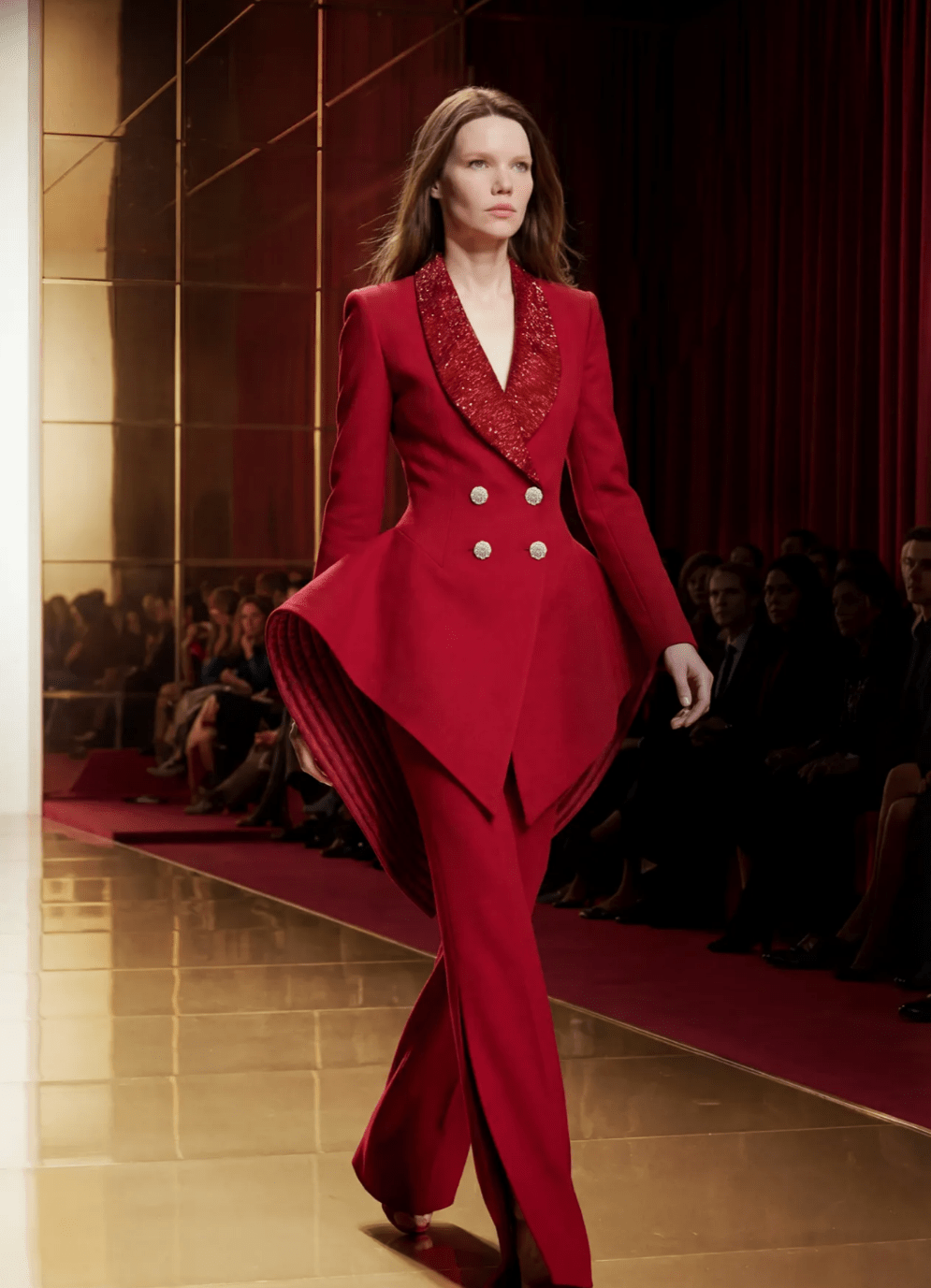
Unlike a traditional show, guests were greeted with wrap-around screens playing an AI-generated video of models walking down a runway, showcasing renderings of the spring collection. Some of these models were recreations of real people, including Mabille’s own mother, whose likeness closed out the show in a white organza wedding dress. It’s also important to acknowledge that none of the pieces featured in the Spring/Summer collection have joined us in the physical world yet. In Mabille’s words, this is a feature of the show: this purely virtual approach allows consumers to visualize themselves in the garment and have it presented in their own measurements.
In an Instagram post, Mabille states that he sees this inclusion of AI as a “forward-looking reflection” of the constant reimagining of Haut Couture. The dictionary definition of Haut Couture refers to “the creation of exclusive custom-fitted high-end fashion design.” When we think of Haut Couture, we generally think of a custom piece, one of one, hand-sewn in everything down to the tiny details. It is obvious, then, that a collection cannot begin to be considered Haut Couture until it exists in the physical world. All things considered, is Mabille’s collection Haut Couture? Is it even fashion? I say no.
Though Mabille describes this collection as “born of the mind and the hand,” fashion’s inexorable connection to the human hand refers to the tactile experience of creation, not simply the act of a person being involved. At every part of the process, physicality plays a major role. The way colors are perceived by the human eye play a part in selecting shades, the feel and stretch of a fabric influence whether or not it would be a good fit for a garment, the alterations and pinning to refine the pinning of the garment, and finally, the body of the model who wears it down the runway. Couture pieces are highlighted in their craftmanship, in some cases entirely hand-stitched or hand-dyed. Even manufactured pieces require the skilled labor of human hands with the assistance of large machinery. Many fashion subcultures are demarcated by their heavy DIY involvement. Simply put, there is no fashion without the physical intervention of human hands in my view. Some may argue that in the case of Mabille’s show, AI was simply a tool used to deliver the original ideas of a human being, since the garments originated as hand-drawn sketches. But without a full understanding of the role AI played in the process, it is difficult for us to discern what is human and what is AI.
From the business side, people adopt AI because it’s cheap and quick. If you want to maximize profit, AI can turn out slop to help you reach your goal as fast as possible without having to wait for artists to develop ideas and create a final product. But this approach is at odds with the foundational philosophies of fashion as a discipline and a means of self-expression. Self-expression is just that; if your so-called self-expression is given to you by a computer or an algorithm, it defeats the purpose of it being an expression of the self.
Regardless of the semantics, the negative impacts of AI outweigh any possible benefit it could bestow. Real people’s likeness used to create degrading content of them has become a significant issue in recent months; anyone who is looking to plug in the faces of those they know should consider the potential of their likeness being abused. Further, the water AI wastes is a huge environmental concern: a Georgia town located next to tone of Facebook’s massive data centers has been practically deprived of water as a result, and early scientific studies have shown that regular use of AI is actually making us dumber. There are also labor concerns; in the creation of a fashion show, there are tons of people that are employed in order to make that happen. Models, makeup artists, backstage coordinators, and stage techs are just some of the people who help make these shows possible. If AI shows were to become the norm, they would eliminate hundreds of job opportunities for people in these industries every year. In my view, the bottom line of AI use in creative industries is saving money and cutting corners. There is no way to merge AI tech and creative industries; one must be sacrificed for the other to thrive.
Yes, technology has progressed to the point where we can create these generative bots like ChatGPT, but just because we can doesn’t mean we should. In an age of convenience, we’ve become accustomed to excess, but we rarely pause to consider the ultimate impact this excess has on us and our environment. At the end of the day, AI is being shoved down our throats because companies need to find something new to sell us, so they prey on disconnection and loneliness by presenting the idea of a “friend” that’s always available and always agrees with you, while they sell your thoughts, fears, and secrets to the highest bidder so they can sell you even more garbage.
It is clear by the tone I’ve adopted here that I am not a big fan of AI. As someone who has adopted a multitude of creative hobbies, I find the usage of AI in creative fields to be at best lazy and uninspired at worst downright insulting. It takes time to develop skills and learn techniques, but engaging in the act and refining those skills is what makes these hobbies fulfilling. There’s a discipline involved that you don’t get from just asking a computer to do the job for you. After all, we are supposed to be doing these things because we enjoy engaging in the process. That being said, the best thing you can do to combat AI is to shut off the computer and make something with your own hands. Ultimately, AI will only take hold if we use it. If people refuse to engage with it, companies will have to give up before they lose more money. But whatever your personal opinion on AI is, it is undeniable that its presence will shape the future of fashion.
The show is available to watch here.
Sources
Cover image from WWD.com.
Alexis Mabille Spring 2026 Couture, Women’s Wear Daily
Alexis Mabille Propels Haut Couture into the Age of AI, Fashion Network
 Fashion Futurist
Leave a comment